

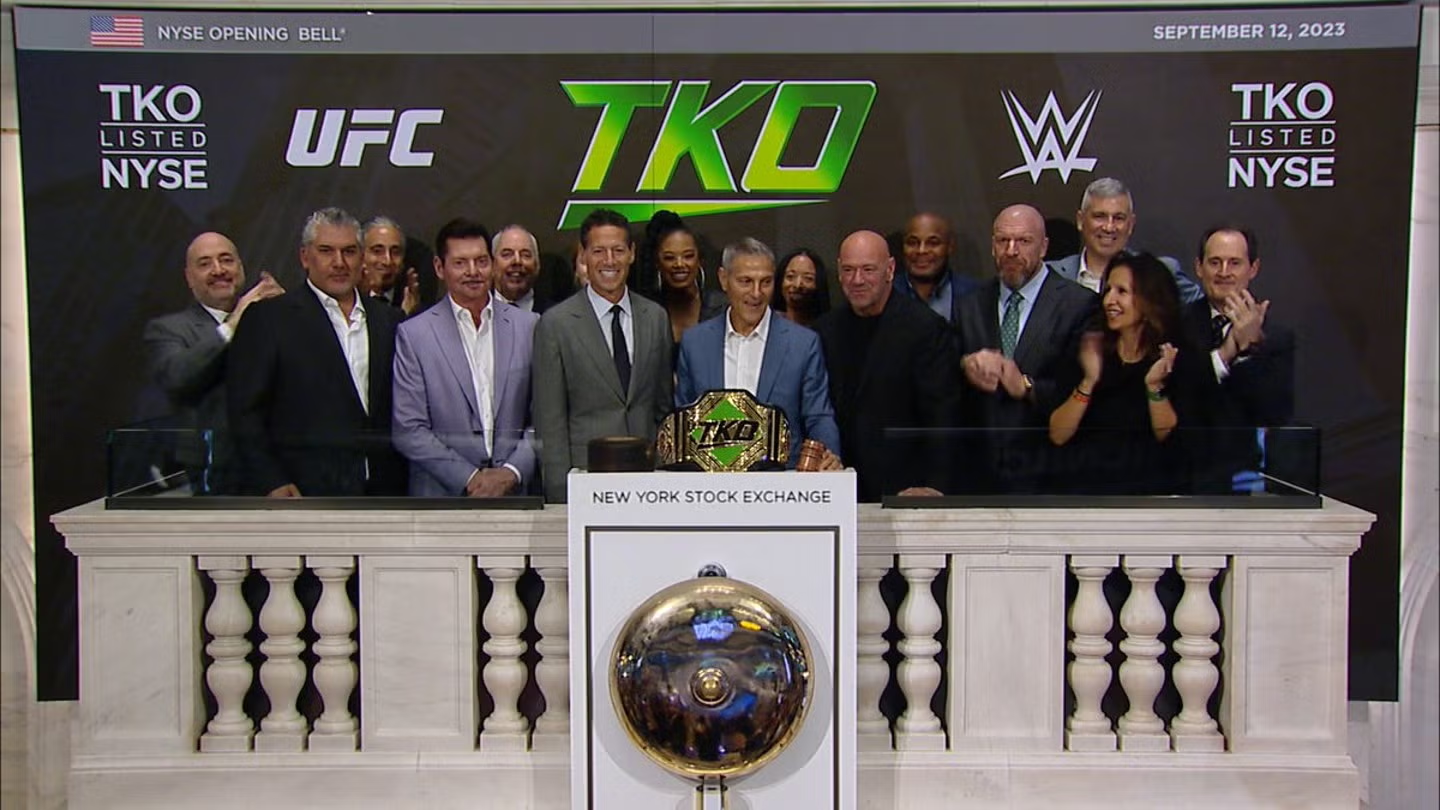
The evolution of professional wrestling from local circuits to global media conglomerates represents one of the most successful corporate transformations in American history. In the United States, sports entertainment is no longer just about the “show”—it is a sophisticated study in capital structure, media rights valuation, and international market expansion.
For students pursuing a degree in finance, the wrestling industry offers a goldmine of data. Whether it is analyzing the TKO Group Holdings merger or evaluating the volatility of publicly traded sports entities, the “Squared Circle” is a living lab for advanced fiscal theory. However, the technical density of these subjects—ranging from Discounted Cash Flow (DCF) models to Derivative Hedging—can be a significant hurdle. This is why many turn to custom assignment help to bridge the gap between fandom and academic mastery.
Key Takeaways for Finance Students
- Valuation Models: Understanding how massive media rights deals dictate the enterprise value of sports brands.
- Operational Efficiency: How “lean” production models in the USA wrestling circuit maximize Profit After Tax (PAT).
- Strategic Diversification: The importance of non-gate revenue, including digital assets and global streaming subscriptions.
- Academic Support: Professional guidance is essential for mastering complex US-based corporate finance modules and data analysis.
The Macro-Economics of Sports Entertainment in the USA
The North American sports market is a massive ecosystem where professional wrestling occupies a unique niche. Unlike traditional sports like the NFL or NBA, wrestling operates on a 52-week production cycle. This lack of an “off-season” creates a consistent and predictable cash flow model that is highly attractive for financial analysts and investors.
Revenue Stream Analysis (2024-2026 Data Trends)
In the current US fiscal climate, the revenue mix for major wrestling promotions has shifted toward digital and broadcast rights.
| Revenue Source | Percentage of Total (Approx.) | Growth Factor (YoY) |
| Media Rights & Content | 72% | +15% |
| Live Events (Gate) | 12% | +8% |
| Consumer Products/Merch | 10% | +5% |
| Sponsorships/Digital | 6% | +22% |
This data shows that the primary “product” is content sold to streaming giants. Calculating the Net Present Value (NPV) of a ten-year media rights contract requires precise mathematical formulas. When these assignments become overwhelming, professional assistance provides the technical accuracy needed to secure top grades.
Technical Framework: The Weighted Average Cost of Capital (WACC)
When a promotion decides to expand into a new territory, they must calculate their WACC to ensure the expansion provides a positive return.
$$WACC = \left( \frac{E}{V} \times Re \right) + \left( \frac{D}{V} \times Rd \times (1 – Tc) \right)$$
For the average student, applying this formula to a volatile industry like entertainment is complex. Market beta—the measure of a stock’s volatility—is constantly shifting. Students often struggle to find the specific “Risk-Free Rate” or “Equity Risk Premium” for the US entertainment sector. This is where expert-led finance assignment help online becomes an invaluable resource, offering data-backed calculations that meet USA academic standards.
Case Study: The TKO Merger and Shareholder Wealth
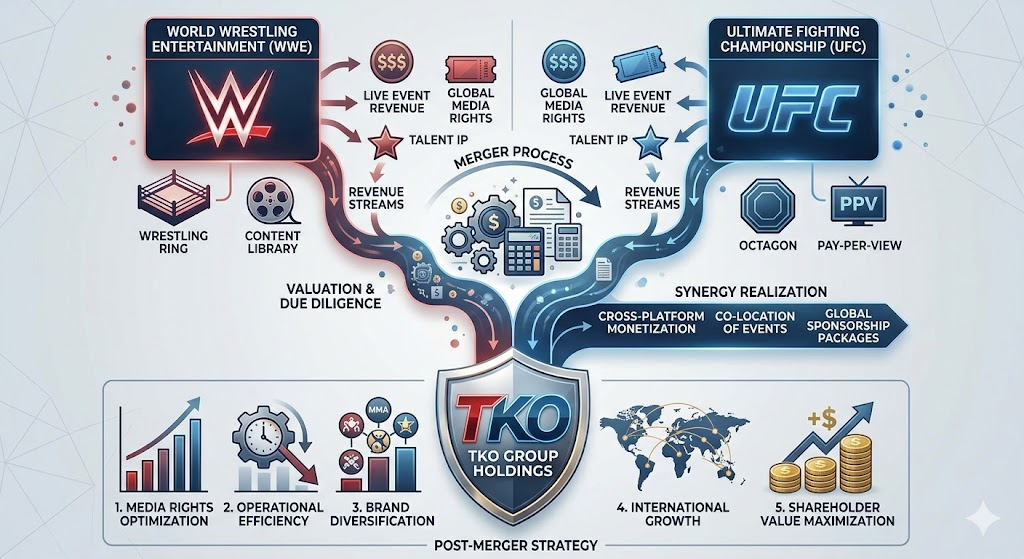
The merger of WWE and UFC to form TKO Group Holdings was a landmark event in Corporate Finance and M&A (Mergers and Acquisitions). Valuing two distinct fan bases and revenue models under a single ticker symbol required rigorous adherence to US GAAP (Generally Accepted Accounting Principles) to ensure transparent reporting to American shareholders.
Synergy Realization in the TKO Merger
The primary financial driver of this deal was the elimination of redundant administrative costs. By consolidating departments such as HR, Legal, and IT, the entity aimed to save millions annually. Analysts track these “synergies” as a way to predict future EBITDA growth.
Debt Servicing and Capital Structure
Managing the massive leverage used to buy out minority shareholders is a critical task. For students, this provides a lesson in how debt can be used as a tool for growth, provided the interest coverage ratio remains healthy.
Market Perception and Stock Volatility
The impact on stock price volatility (Alpha and Beta coefficients) after a merger is a key area of study. By mid-2025, TKO showed a significant increase in Free Cash Flow (FCF), signaling to the market that the merger was accretive rather than dilutive. If you find yourself lost in these complex SEC filings, specialized academic support can help you deconstruct these case studies with professional clarity.
Risk Management: The “Independent Contractor” Financial Model
In the USA, most professional wrestlers are classified as independent contractors. From a financial perspective, this shifts the burden of Variable Costs (travel, insurance, equipment) from the corporation to the individual.
Impact on Financial Statements
Under US GAAP, this model allows companies to lower “Fixed Labor Costs” and significantly improve the Operating Margin. However, for the athlete, it requires sophisticated personal tax planning and “S-Corp” structures to mitigate tax liabilities.
Students often perform a Break-Even Analysis on whether an athlete should sign a guaranteed contract or stay independent. These calculations require a firm grasp of Managerial Accounting.
Global Market Expansion and Exchange Rate Risk
As USA-based companies expand internationally, they face Forex (Foreign Exchange) Risk. If the US Dollar strengthens, the revenue earned from international tours can shrink when converted back for reporting.
To mitigate this, financial directors use Hedging Strategies, such as:
- Forward Contracts: Locking in exchange rates for future dates.
- Currency Options: Giving the company the right to swap currencies at a set rate.
Explaining the “Greeks” (Delta, Gamma, Theta) in currency options is one of the hardest parts of a finance degree. Specialized technical guidance provides the competitive edge needed to explain these derivative instruments accurately.
FAQs: Finance in Sports Entertainment
Q1: How does US GAAP influence wrestling financial reports?
US GAAP ensures that revenue from multi-year media deals is recognized correctly over the life of the contract, preventing companies from artificially inflating their current-year earnings.
Q2: Why is “Media Rights” considered the most stable financial metric?
Unlike ticket sales, media rights are multi-year, guaranteed contracts. This creates “unearned revenue” on the balance sheet, providing a safety net for investors.
Q3: Can I get help with technical finance assignments involving sports data?
Yes. Utilizing expert academic services allows you to access professionals who understand how to apply theories like CAPM to real-world data.
Conclusion: The Final Count
In the world of finance, the winner is the one who manages their resources most effectively. By analyzing media rights, mastering WACC formulas, and adhering to US GAAP, you are building the skills needed for a high-flying career in the USA’s financial sector. And when the academic workload starts to feel like a “Steel Cage Match,” remember that professional assistance is the ultimate tag-team partner.
About the Author
Lachlan Miller is a senior strategist and consultant at MyAssignmentHelp, specializing in corporate finance and SEO-driven academic content for the USA market. With a decade of experience in financial analysis, he bridges technical frameworks with sports entertainment trends, providing students with high-authority, data-driven insights to master complex academic subjects.

