

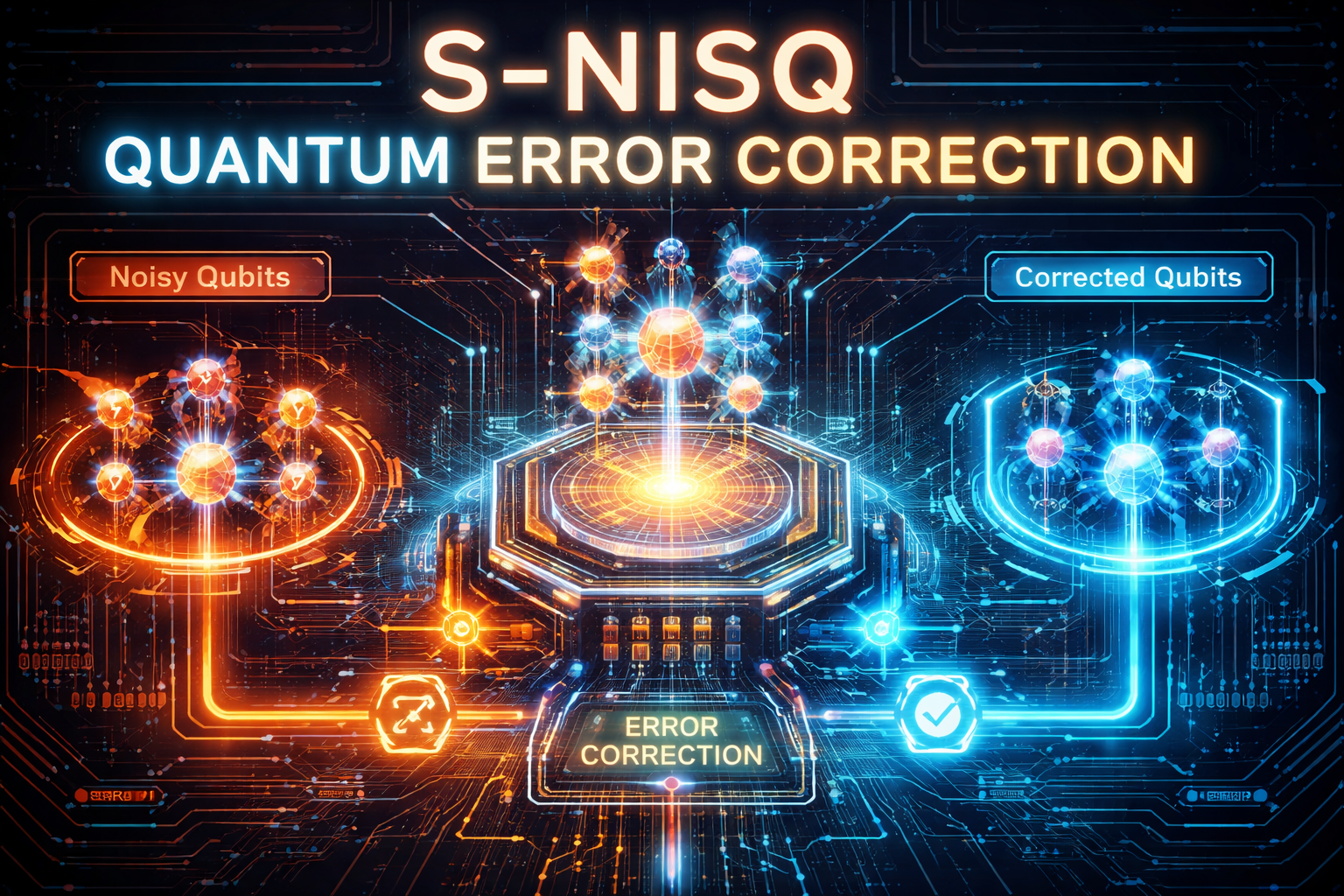
Introduction to S-NISQ Quantum Error Correction
Quantum computing has made impressive strides in recent years, but we’re still firmly in what researchers call the NISQ era—Noisy Intermediate-Scale Quantum. These machines are powerful enough to explore interesting problems, yet still too error-prone for fully reliable, large-scale computation. That’s where S-NISQ quantum error correction comes into play. The “S” often refers to scalable or specialized approaches tailored to near-term devices, making this concept both practical and forward-looking.
At its core, S-NISQ quantum error correction is about making imperfect quantum systems more useful without demanding the heavy overhead of full fault-tolerant quantum computing. Traditional error correction methods require thousands of physical qubits to protect a single logical qubit, which simply isn’t feasible with current hardware. S-NISQ strategies, on the other hand, aim to work within these limitations by being clever, adaptive, and resource-efficient.
What makes this approach exciting is its realism. Instead of waiting for perfect machines, researchers are designing error mitigation and correction techniques that can be implemented today or in the near future. This means we can start extracting meaningful results from quantum devices much sooner than previously expected.
Understanding Errors in NISQ Devices
To appreciate the importance of S-NISQ quantum error correction, you need to understand the types of errors that plague quantum systems. Unlike classical computers, where errors are rare and easily corrected, quantum systems are extremely sensitive to their environment. Even tiny disturbances can cause qubits to lose their quantum state—a phenomenon known as decoherence.
There are several kinds of errors in NISQ devices. Bit-flip errors occur when a qubit changes from |0⟩ to |1⟩ or vice versa. Phase-flip errors, on the other hand, alter the phase relationship between quantum states. Then there are gate errors, which happen when quantum operations don’t execute perfectly due to hardware limitations. All of these errors accumulate quickly, making long computations unreliable.
Another major challenge is noise variability. NISQ devices don’t behave consistently; error rates can change over time, across qubits, and even depending on the type of operation. This unpredictability makes it difficult to apply rigid error correction schemes. S-NISQ approaches address this by being adaptive and often hardware-aware, tailoring solutions to the specific noise characteristics of a given device.
What Makes S-NISQ Error Correction Different?
Traditional quantum error correction is built on the idea of redundancy—encoding one logical qubit into many physical qubits to detect and correct errors. While theoretically powerful, this method is extremely resource-intensive. S-NISQ error correction takes a different path by focusing on efficiency rather than perfection.
One key difference is the emphasis on error mitigation instead of full correction. Instead of completely eliminating errors, S-NISQ techniques aim to reduce their impact on the final result. This might involve running the same circuit multiple times and statistically correcting the output, or using clever calibration techniques to counteract known noise patterns.
Another distinguishing feature is hybridization. S-NISQ methods often combine classical and quantum processing to improve accuracy. For example, a classical optimizer might adjust quantum circuit parameters in real time to minimize error effects. This hybrid approach leverages the strengths of both computational paradigms, making it particularly well-suited for near-term devices.
Finally, S-NISQ error correction is highly customizable. Different quantum hardware platforms—such as superconducting qubits, trapped ions, or photonic systems—have unique error profiles. S-NISQ techniques are designed to adapt to these differences, rather than applying a one-size-fits-all solution.
Key Techniques in S-NISQ Quantum Error Correction
Several techniques have emerged as cornerstones of S-NISQ quantum error correction. One of the most widely used is zero-noise extrapolation (ZNE). This method involves artificially increasing the noise in a system and then extrapolating back to estimate what the result would be in a noise-free scenario. It’s a clever workaround that doesn’t require additional qubits.
Another important technique is probabilistic error cancellation (PEC). This approach uses knowledge of the noise model to mathematically “invert” the errors. While powerful, PEC can be computationally expensive and requires precise characterization of the system’s noise, which isn’t always easy to obtain.
There’s also growing interest in subspace expansion methods, where computations are performed in a carefully chosen subset of the quantum state space. By restricting operations to more stable regions, these methods can reduce the likelihood of errors without adding significant overhead. Combined with classical post-processing, they can significantly improve result accuracy.
These techniques are often used together rather than in isolation. The flexibility to mix and match methods is one of the defining strengths of S-NISQ approaches, allowing researchers to tailor solutions to specific problems and hardware constraints.
Practical Applications and Use Cases
S-NISQ quantum error correction is already enabling meaningful progress in several application areas. One prominent example is quantum chemistry. Simulating molecular systems requires high precision, and even small errors can lead to incorrect predictions. S-NISQ techniques help stabilize these calculations, making them more reliable on current hardware.
Optimization problems are another area where S-NISQ shines. Algorithms like the Variational Quantum Eigensolver (VQE) and Quantum Approximate Optimization Algorithm (QAOA) rely heavily on iterative processes. Error mitigation ensures that each iteration produces useful data, improving the overall convergence of these algorithms.
Machine learning is also benefiting from S-NISQ methods. Quantum machine learning models often involve complex circuits that are highly sensitive to noise. By applying error mitigation techniques, researchers can extract cleaner signals from these models, making them more practical for real-world use.
What’s exciting is that these applications are not theoretical—they’re being actively explored and tested on real quantum devices today. S-NISQ error correction is playing a crucial role in turning quantum computing from a purely experimental field into a tool with tangible value.
Challenges and Limitations
Despite its promise, S-NISQ quantum error correction is not without challenges. One of the biggest limitations is scalability. While these techniques work well for small to medium-sized systems, their effectiveness can diminish as circuits grow larger and more complex.
Another issue is the cost of classical computation. Many S-NISQ methods rely heavily on classical post-processing, which can become a bottleneck. In some cases, the classical overhead required to mitigate errors can outweigh the benefits of using a quantum computer in the first place.
There’s also the challenge of accurate noise modeling. Techniques like probabilistic error cancellation depend on a precise understanding of how errors occur in the system. However, noise in quantum devices is often complex and difficult to characterize, which can limit the effectiveness of these methods.
Finally, there’s the question of standardization. The field is still evolving, and there’s no universally accepted framework for S-NISQ error correction. This can make it difficult to compare results across different platforms and approaches, slowing down overall progress.
The Future of S-NISQ Quantum Error Correction
Looking ahead, S-NISQ quantum error correction is likely to remain a critical area of research for the foreseeable future. As quantum hardware improves, these techniques will evolve alongside it, becoming more sophisticated and effective.
One promising direction is the integration of machine learning into error correction. By using AI to model and predict noise patterns, researchers can develop more adaptive and efficient mitigation strategies. This could significantly reduce the need for manual calibration and tuning.
Another exciting development is the gradual transition toward fault-tolerant quantum computing. S-NISQ methods can serve as a bridge, helping researchers test and refine ideas that will eventually be used in fully error-corrected systems. In this sense, they’re not just a temporary solution—they’re a stepping stone to the future.
Ultimately, S-NISQ quantum error correction represents a pragmatic approach to a very difficult problem. It acknowledges the limitations of current technology while still pushing the boundaries of what’s possible. And that balance—between ambition and realism—is exactly what makes it so impactful in the world of quantum computing.

